Key Points:
1. Bend elbows, resting forearms flat on the balance pad. Support yourself on the balls of your feet, keeping ears, shoulders, hips, and ankles in a straight line.
2. Push elbows toward feet while curling toes forward, keeping torso stable.
3. Maintain tension throughout shoulders, back, and abdomen; engage core to prevent lower back sagging.
4. Breathe evenly and keep torso stable throughout; rest when fatigued.
5. This exercise further strengthens players' core muscles, reducing the risk of back and spinal injuries during games.
Balance training is a crucial element for enhancing basketball players' equilibrium. Beyond improving balance, drills can incorporate basketballs or other equipment for targeted practice alongside bodyweight exercises.
Balance training can enhance the quality of our daily lives and reduce the risk of fall-related injuries.
Maintaining human balance (body stability and homeostasis) is ensured through three systems:
(1) The inner ear system: The inner ear keeps your body level;
(2) The proprioceptive system: Proprioception coordinates balance;
(3) Visual system: Through proprioceptors in sensory nerves (located in tendons and joints), they transmit neural signals to the central nervous system, providing movement information or awareness of body position and spatial orientation; the visual system captures information via the eyes and informs the brain of the body's spatial position within the environment.
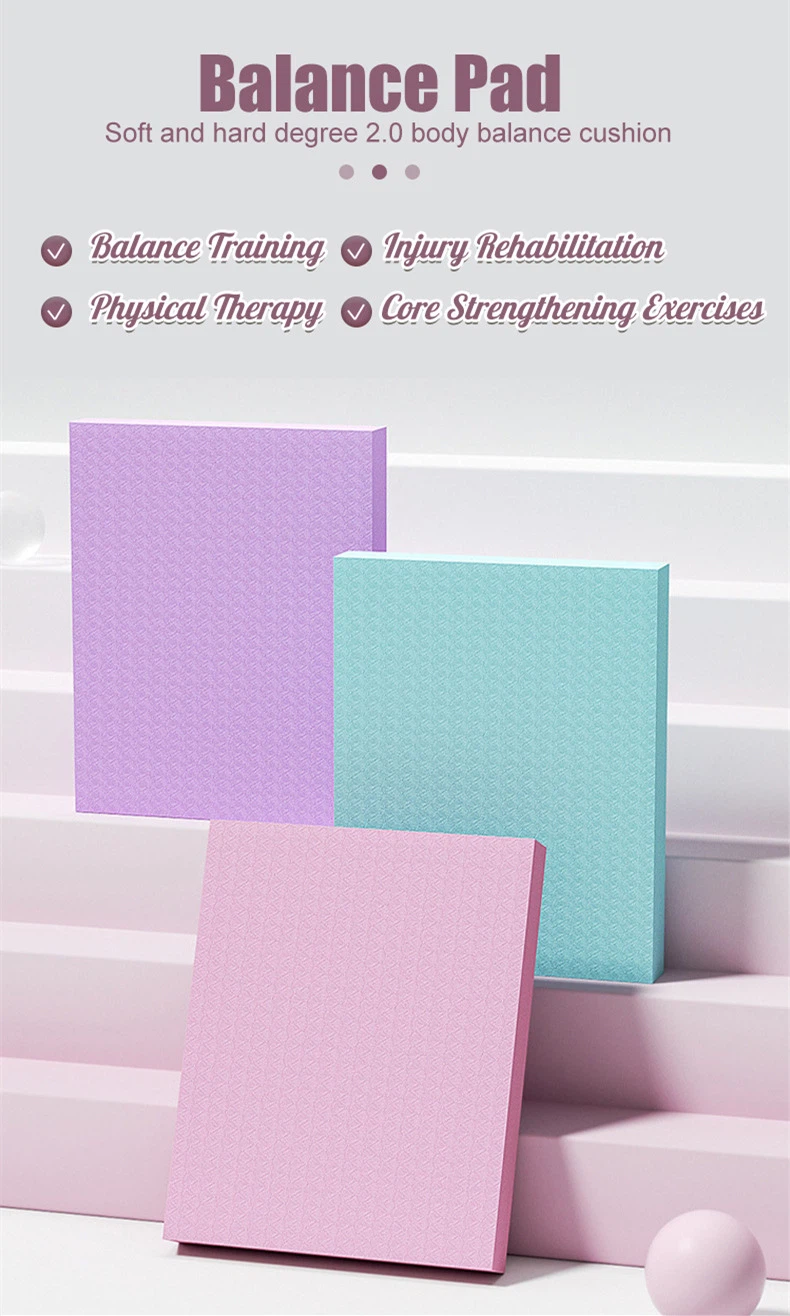
Balance pads stimulate the skin's fine tactile senses, allowing us to perceive the position of feet, knees, hips, and limb balance. The raised dot pattern on the surface increases friction, stimulating the sensory system and training proprioception. Additionally, the unsteady surface engages muscles responsible for balance and strengthens core muscles.
Standing Static on Both Feet
Key Points: Stand with both feet on the pad to find your balance point. Keep your body as upright as possible. You can advance this by trying to stand with your eyes closed.
Single-Leg Standing on Mat
Key Points: Stand on one foot on the mat to find your balance point, keeping the other foot suspended. Maintain balance while standing, then alternate sides.
Squatting with Both Feet on Mat
Key Points: Stand with both feet on the mat to find your balance point, keeping your body as upright as possible. Perform squats, rising and lowering slowly while maintaining balance. Gradually increase repetitions to challenge yourself.
Single-Leg Swallow Balance on Mat
Key Points: Begin with both feet on the mat. Slowly shift weight to one leg, keeping it straight. Extend the other leg upward, keeping your back straight and arms stretched out. Hold this "swallow" pose, alternating sides.